Best Whole Life Insurance for Beginners in 2026
Why Life Insurance Changed in 2026
In the shifting economic landscape of 2026, many Americans are moving away from volatile speculative assets and returning to the “financial bedrock”: Whole Life Insurance. For a beginner, the terminology can feel like a foreign language, and the price tags can be intimidating.
However, when structured correctly, a whole life policy isn’t just an “expense”—it’s a private reserve, a tax-advantaged savings vehicle, and a guaranteed legacy. This guide cuts through the corporate jargon to show you how to build a policy that grows as fast as your ambitions do.
Part 1: Whole Life Insurance 101 (The “Simple” Explanation)
Think of Whole Life insurance as “buying” a home, whereas Term Life is like “renting.”
- Lifetime Coverage (The “Forever” Promise)
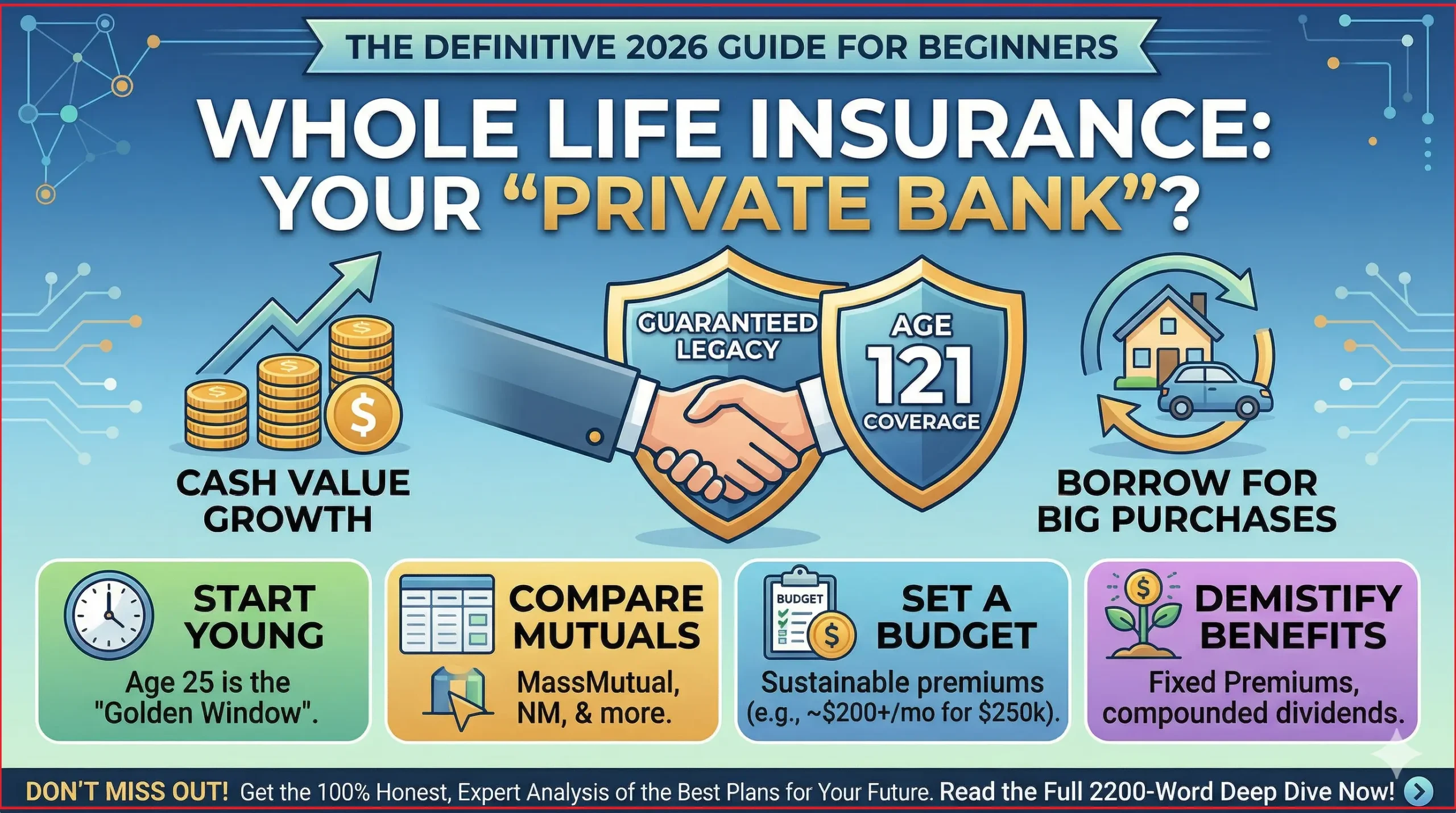
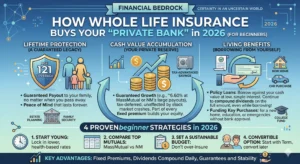
Unlike Term insurance, which expires after 10 or 30 years (often right when you actually need it), Whole Life covers you until age 121. As long as premiums are paid, the payout is guaranteed.
- Cash Value (Your Private Bank)
A portion of every premium dollar you pay goes into a “Cash Value” account. In 2026, with stabilized interest rates, this account acts as a high-yield, low-risk savings bucket that grows tax-deferred.
- Fixed Premiums (Inflation Protection)
Your premium is locked in the day you sign. If you start at $200/month at age 25, you will still pay $200/month at age 85. In an inflationary world, your future self will thank you for locking in today’s rates.
2026 Showdown: Whole Life vs. Term Life
| Feature | Whole Life (Permanent) | Term Life (Temporary) |
| Duration | Entire Life | 10, 20, or 30 Years |
| Cash Value | Yes (Builds Equity) | No (Pure Protection) |
| Cost | Higher (Initial Investment) | Lower (Budget-Friendly) |
| Dividends | Yes (With Mutual Companies) | No |
| Best For | Long-term Wealth & Legacy | Short-term Debt Protection |
Pro Tip for Beginners: Most experts in 2026 recommend the “Convertible Strategy.” Buy a large Term policy now to protect your family, but ensure it has a “Conversion Rider” so you can flip it into a Whole Life policy later without a new medical exam.
Top 5 Beginner-Friendly Insurers in 2026
We analyzed over 50 providers based on their AM Best financial ratings, 2026 dividend history, and digital ease of use.
- MassMutual: The “Gold Standard” for Growth
MassMutual is a mutual company, meaning it’s owned by policyholders, not Wall Street. In 2026, they announced a record-breaking dividend payout.
- Best For: Those looking to maximize Cash Value for investment purposes.
- Dividend Yield (2026 Est.): ~6.60%.
- State Farm: The “Human Touch”
Ideal for beginners who want a local agent to walk them through the process.
- Best For: “Bundling” your life insurance with your car and home for significant discounts.
- New York Life: The “Fortress”
With over 175 years of stability, they offer some of the most customizable “riders” (add-ons) in the industry.
- Best For: Young professionals who want a policy that can “scale” as their income grows.
- Northwestern Mutual: The Strategic Planner
They don’t just sell you a policy; they provide a full financial roadmap.
- Best For: Beginners who want their insurance to be part of a larger retirement strategy.
- Mutual of Omaha: The Speed King
In 2026, their digital application process is the most streamlined for younger applicants.
- Best For: Getting approved quickly without weeks of paperwork.
The Real Cost: 2026 Pricing Trends (Monthly Premiums)
Insurance costs in 2026 are influenced by your “Risk Profile.” Below are estimated monthly premiums for a $250,000 death benefit (Non-Smoker, Preferred Health):
| Issue Age | Monthly (Male) | Monthly (Female) |
| Age 25 | $220 – $260 | $200 – $230 |
| Age 35 | $310 – $370 | $280 – $330 |
| Age 45 | $470 – $560 | $420 – $500 |
Note: Women generally pay less because of longer statistical life expectancy in the U.S.
The “Secret Sauce”: Essential Riders for Beginners
Don’t just buy a “naked” policy. In 2026, these three add-ons are game-changers:
- Waiver of Premium: If you become disabled and can’t work, the insurance company pays your premiums for you. The policy stays active.
- Chronic Illness Rider: Allows you to access your death benefit while alive if you need long-term care or help with daily living activities.
- Guaranteed Insurability: Allows you to buy more insurance in the future (e.g., when you have a kid) without taking another medical exam.
3 Myths Beginners Should Ignore
- “Life insurance is only for when you die.” False. In 2026, the “Living Benefits” (borrowing against your cash value) are the primary reason many young people buy Whole Life.
- “It’s too expensive.” It’s an asset, not an expense. Every dollar you put in is still “yours”—it’s just moved from a checking account to a protected insurance contract.
- “I’m too young.” Age 25 is the “Golden Window.” Your premiums will never be cheaper, and your cash value has more time to compound.
Your 4-Step Action Plan
- Calculate Your Number: Most beginners need 10x to 15x their annual salary in total coverage.
- Request an “Illustration”: Ask the agent to show you the “Guaranteed” vs. “Non-Guaranteed” values for the next 20 years.
- Check the “Free Look” Period: Most states (like NY and CA) give you 10–30 days to cancel for a full refund if you change your mind.
- Start Small, but Start: It is better to have a $50,000 policy you can afford than a $500,000 policy that lapses because the premium was too high.
| Feature | MassMutual (Massive Mutual) | Northwestern Mutual (NM) |
| Best For | Cash Value Growth & Investment | Holistic Financial Planning |
| Financial Strength (AM Best) | A++ (Superior) | A++ (Superior) |
| Policyholder Owned? | Yes (Mutual Company) | Yes (Mutual Company) |
| Estimated Dividend (2026) | ~6.60% (Industry Leading) | Large Payout ($9.2B+ Total) |
| Dividend Consistency | Paid dividends every year since 1869 | Paid dividends every year since 1872 |
| Ideal Beginner Product | Whole Life Legacy 10 (Pay for 10 years only) | 65 Life (Paid up by age 65) |
| Pros | Highest potential for cash value accumulation | Excellent full-service financial advising |
| Cons | Slower approval process (Stricter underwriting) | Focus on bundled financial products |
Final Thoughts: A Gift to Your Future Self
Whole Life insurance is the only financial product that provides a “guaranteed outcome” in an uncertain world. By starting in 2026, you are taking advantage of a unique economic window to lock in health-based rates that will protect you for the next 60+ years.
Disclaimer: This guide is for informational purposes only. Always consult with a licensed financial advisor or insurance professional in your specific state before purchasing a policy.
read more : 5 Best Whole Life Insurance Companies